Showing posts with label Hindi. Show all posts

Monday, March 3, 2014

Indian Script : DEVANAGARI

Devanagari is one of the scripts used in India. Today it is officially used for writing Hindi, Sanskrit and Marathi. If you are planning to visit India, this is the script you will most probably see everywhere - on boards, billboards, panels, signs etc. In this article you can learn more about devanagari and how to write/read it.

~°~

Devanagari is an old Indian script. It derived from even older script brahmi (used on king Ashoka's edicts who converted to Buddhism after a heavy bloody battle) which derived from Aramaic script. This means we can trace back the origins of devanagari all the way in to early centuries BC. The earliest texts written with devanagari were composed in 8th century. The name, devanagari, consists of two Sanskrit words - deva (God, deity) and nagari (nagar=city; nagari (F)=of the city, town) which together form one meaning - (the script = lipi) of god's city (F). It is written from left to right and there is no difference between upper- and lowercase letters

Devanagari is a phonetic and syllabic script. That means it is written mostly as you read it and every consonant will come with a vowel, in this case a short vowel a. Therefore it is not quite correct to call devanagari as an alphabet. Some authors of Hindi grammar books say that devanagari is the most scientific script. The reason for that is the order in which letters (or syllables) are put. Letters are distributed according to their place and way of articulation. The order they are put in is called as varnmala - garland of letters. If you try to speak the letters you will notice many regularities on your own as well.

Vowels are written in two ways. the way of writing depends if they follow a consonant or not. Consonants are always written in the same way except when they are in clusters. Here you can briefly see the rules of writing devanagari. Handwritten devanagari is a bit different, however, not much different. The line above the letters is one of the most characteristic features of this Indian script. 


Hindi alphabet script devanagari
Devanagari - vowels and consonants

hindi devanagari vowels
Devanagari - vowels

Although it might seem difficult to learn devanagari because there are so many letters, it is actually no different than any other script. You can start out with writing down your own name - later you can frame it and put it as a decoration (Make Your Home More Indian). Once you get it right, you will be able to write it and read it just as fast as you are reading this article right now. And after all, it is quite cool once you come to India knowing you can read the menu in devanagari in a restaurant or boards with the name of the cities!


Wednesday, January 1, 2014

HAPPY NEW YEAR in Indian languages!!

Wishing your friends and family a very happy and prosperous new year ahead :)
~°~

Bengali: Shubho Nabo Barsho
Gujarati: Nutan Varshbhinandan
Hindi: Naye Varsha Ki Shubhkamanyen
Kannada: Hosa Varushadha Shubhashayagalu
Marathi: Naveen Varshachy Shubhechcha
Punjabi: Nave saal di Mubarak
Sindhi: Nayou Saal Mubbarak Hoje
Singhalese: Subha auth awrudhak vewa
Tamil: Inniya Puthaandu Nalvazhthukkal
Telugu: Noothana samvatsara Shubhakankshalu
Urdu: Naya Saal Mubbarak Ho

~ HAPPY NEW YEAR :) ~

Happy New Year

Are there any more languages you would like to add? Let us know! :)
Follow Spicy Bharat on G+, FB, comment or send us an email! 

Sunday, December 15, 2013

Building up your Hindi vocabulary!

Here are some tips on how to improve your Hindi vocabulary!
~°~
Master Hindi Language Quickly

1. Bit by bit
- it is always better to revise often and slowly adding new ones than learn huge amount of words every now and then.

2. Use what you  have learned right away!
- whichever word or phrase you have just learnt - use it! Write a short essay, talk to your friends... just mention it in any way.

3. Visual dictionaries
- if you are a person who likes to learn by seeing the image the certain term represents, this is an awesome solution to you. These kind of dictionaries often put words in categories so you learn the context as well.

4. Memo cards vs notebooks
- instead of having a huge mess in the notebook, keep different cards within it. For example, title one card as "Sabji" (vegetable) and whenever you learn a new vegetable, write it down on that card. This is a great way to see how your vocabulary is improving and also a great way to keep track of the amount of the words you know of each category.

5. Indian friends!
- official languages of India are Hindi, English and any local language that has the status of  official language. Most of the Indians can speak in Hindi, even though it might not be their mother tongue. If you have Indian friends, practise with them! :)

6. Bollywood films
- watch Bollywood films. Try to hear out some words, check their meanings and write them down. What you hear in the film is most likely to be conversational Hindi and can be of great use!

Good Luck!
In this article you can learn more about the script in which Hindi is written DEVANAGARI while in the article Meet Hindi Language you can learn more about Hindi language in general if you are not familiar with it.

Friday, December 13, 2013

Meet Hindi Language

Hindi is an Indoeuropean language that is an official language of Republic of India. Today more than 200 MILLION people can speak Hindi. It is also the language of Bollywood films.

~°~

It is commonly misunderstood that Hindi is a very difficult language to learn. Actually, if you are a native speaker of any of the Indoeuropean language, it should be easier than learning Chinese, Turkish or any other non-Indoeuropean language - even though it might sound very "exotic" to you. 

It has developed from Sanskrit - an ancient language such as Greek and Latin but, however, still has native speakers! So, you see - what is Latin to Spanish, exactly the same is Sanskrit to Hindi - a parent :) Native Hindi speakers will not have much problems with understanding Sanskrit as much as native speakers of Slavic languages will not have problems with understanding Old Slavonic and native speakers of Roman languages - Latin. If you are a native speaker of, for example, any of the Slavic languages and you had to learn Latin at school - you can understand Roman languages easier. The point is, Indoeuropean languages follow almost the same rules and their constructions will be somewhat very similar. There is no need to be scared of Hindi just because you do not have an opportunity to hear it on the TV very often - being an Indoeuropean language, it is already closer to your own mother tongue than other "exotic" languages.

Hindi is written in Devanagari script. A very old script whose tracks we can follow all the way to Aramaic script. Today it is officially used for writing Hindi, Marathi and Sanskrit language. In this article you can learn more about this Indian Script : DEVANAGARI. It is really fun to learn! There are many tutorials on how to write and read Devanagari. Also there are many tutorials about Hindi understanding the Hindi grammar. There are not many, however, tutorials on building Hindi vocabulary so from time to time we will try to work on that topic over here as well :)

Let us know in the comments if you have already tried to learn Hindi and how did you like it! You can also LIKE Spicy Bhaarat on Facebook and Google+.

Here are some tips on how to build up your Hindi vocabulary - Building up your Hindi vocabulary!

Hindi Language


Friday, October 11, 2013

Words Every Desi-wannabe Should Know!

If you are a desi-wannabe, here are some words which you must be familiar with :)


~°~
Desi
Comes from the word des / desh - meaning country. Desi means a person of the country, local or simply Indian. it is opposite to pardesi - meaning foreign, or a foreigner.

From the movie Dostana - song Desi Girl


Yaar
Word which is equivalent to friend, dude or man.

Yaar - dude


Achchha!
Sometimes spelled as achha, atchha, achcha, acha and so on. It literally means good, OK, but according to the context also right, really. Achchha can show your surprise and / or agreement too.

Rahul : Hey Mina, there is no such word as impossible in my dictionary.
Mina: Oh really... where have you bought such a lousy dictionary??
...flirt fail ;) ...


Wala
You will hear this word after certain nouns or verbs. It means a person who is in charge of. For example - chaywala - person who makes/sells teas.

Chaywala


Aunty and Uncle
When not in very formal situations, this is how you will refer to your Indian friends' parents, shopkeepers or anyone in general who is older than you but not very old in general (then you ought to use politer terms).
It would be great if you add ji after aunty or uncle - it is a particle of showing your respect to the person.

Indian parents


...na?
A particle used when you want to ask something like - What about you? Isn't it? Right?

Gosh, what are you saying? Your health is fine, isn't it?
(Annoying FB girl meme)

Thursday, October 10, 2013

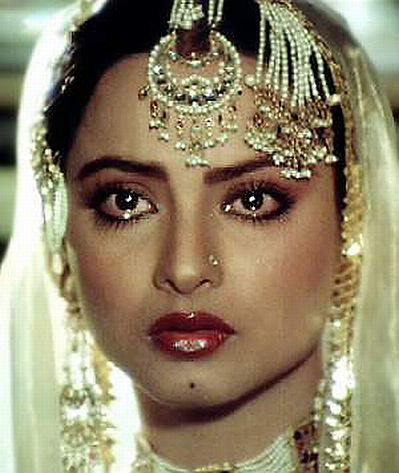
Happy Birthday Rekha!


Today is Rekha's 58th birthday!

Rekha has been an actress since 1966. She is the first Umrao Jaan. The next Bollywood film she will appear in is Krrish 3 - sequel of Krrish 2 and Koi Mil Gaya.
HAPPY BIRTHDAY!


Rekha - a recent photo
Rekha as Umrao Jaan
Rekha - a Bollywood Actress